
You finally pulled the trigger on that shiny new electric vehicle, but after three days of using the “mobile connector” that came with the car, reality is starting to set in. Plugging into a standard 120V wall outlet—what we call Level 1 charging—is like trying to fill a backyard swimming pool with a literal teaspoon. You wake up after ten hours of charging only to find you’ve added a measly 40 miles of range. It is frustrating, inefficient, and honestly, it ruins the “convenience” of never going to a gas station again. If you have a commute longer than a few miles, that Level 1 cable is basically an emergency backup, not a daily solution.
This is exactly why a proper Level 2 charging installation is the very first upgrade every EV owner should prioritize. Moving to a 240V system transforms your ownership experience from “constantly checking the percentage” to “waking up with a full tank every single day.” But walk into any tech store or browse online, and you are immediately bombarded with specs: Amps, Volts, Kilowatts, J1772, NACS, and hardwired vs. plug-in options. It feels less like buying a home appliance and more like a high-stakes electrical engineering exam.
We are going to cut through that noise. In this EV home charger review and guide, we are looking at the critical hardware decisions you need to make before the electrician shows up. We will look at why “more power” isn’t always better and how to future-proof your garage without lighting your wallet on fire. Let’s get your home ready for the electric revolution, one circuit breaker at a time.
Decoding the Power: 32, 40, or 48 Amps?
The most common mistake we see is people buying the “fastest” charger available without checking if their house—or even their car—can actually handle it. Most Level 2 stations fall into three categories: 32-amp, 40-amp, and 48-amp units. To understand which one you need, you have to look at your car’s “onboard charger” limit. If you drive an older EV or a plug-in hybrid that maxes out at 7.2 kW, buying a 48-amp (11.5 kW) station won’t make your car charge any faster. The car will only take what it can handle, and you’ll have spent an extra $200 for power you can’t use.
However, we usually suggest “over-provisioning” for the future. Even if your current car is limited, your next car probably won’t be. A 40-amp charger is the “sweet spot” for most American homes. It provides about 30 miles of range per hour, which is more than enough to fill almost any EV battery overnight. Crucially, a 40-amp charger can often be installed without a massive, multi-thousand-dollar upgrade to your home’s main electrical panel. Once you step up to 48 or 50 amps, the wire gauge gets thicker, the breakers get more expensive, and the labor costs start to skyrocket.
Expert insight: Remember the “80% Rule” for electrical safety. A circuit should only carry 80% of its rated load for continuous use. If you want to charge at 40 amps, you need a 50-amp circuit breaker. If you want the full 48-amp experience, you’re looking at a 60-amp breaker and heavy-duty 6-gauge wiring. Always verify your panel’s total capacity before clicking “buy.” If your panel is already full of high-draw appliances like AC units and electric dryers, you might need a “smart load shedder” to avoid a total panel upgrade.
Hardwired vs. Plug-in: Which is Better for Your Garage?
When you look at the best home EV chargers, you’ll notice they come in two flavors: units that plug into a NEMA 14-50 outlet (like a heavy-duty dryer plug) and units that are “hardwired” directly into a junction box. There is a heated debate in the EV community about which is superior, but it really comes down to your living situation. A plug-in unit offers portability; if you move houses or your charger breaks, you just unplug it and take it with you. It’s a “plug-and-play” solution that many homeowners find less intimidating.
But here is the “insider” secret: hardwiring is technically superior for long-term reliability. Every time electricity passes through a plug-and-socket connection, there is a tiny bit of resistance, which creates heat. Over years of daily, high-current charging, those cheap plastic outlets can degrade or even melt if they aren’t “industrial grade.” Hardwiring removes that point of failure entirely. Furthermore, if you want the highest speeds (48 amps or higher), the National Electrical Code (NEC) actually requires the unit to be hardwired. You simply cannot pull that much sustained current through a standard plug safely.
Hypothetical example: Imagine you’re building a new home. We would always tell you to hardwire. It looks cleaner, it’s more secure, and it’s usually cheaper because you aren’t paying
Do You Actually Need a “Smart” Charger?
This is where the marketing teams really go to town. You’ll see chargers with beautiful color touchscreens, built-in WiFi, and apps that track every penny you spend on electricity. These are “Smart” chargers, like the ChargePoint Home Flex or the Wallbox Pulsar Plus. They are fantastic tools, but before you pay the “smart tax,” ask yourself: “Doesn’t my car already do this?” Most modern EVs, especially Teslas, Rivians, and Hyundais, have excellent apps that allow you to schedule charging for middle-of-the-night off-peak hours.
If your car already manages the schedule, a “Dumb” charger—a high-quality, UL-listed box that just delivers power—might be all you need. Units like the Grizzl-E Classic are famous for being “built like a tank” with zero software to glitch out. There is something to be said for a charger that doesn’t need a firmware update just to put juice in your battery. We’ve seen many “smart” chargers become “dumb” ones anyway when the owner’s garage WiFi signal is too weak to reach the unit.
However, there is one scenario where a smart charger is non-negotiable: utility rebates. Many power companies will offer you a $500 rebate or lower electricity rates if you install a specific smart charger that they can “talk” to. This allows them to throttle your charging during a grid emergency to prevent a blackout. If your utility company is cutting you a check for the best home EV chargers, then by all means, get the smartest one on the list. Just ensure the app is compatible with your smartphone and has a high rating in the app store; a bad app can make a great charger feel like a burden.
The Installation Process: Avoiding the “EV Tax”
Here is a piece of advice that will save you hundreds: when you call an electrician for a Level 2 charging installation, don’t lead with “I need an EV charger installed.” Some contractors see a Tesla in the driveway and immediately double their labor rates—it’s the “EV Tax.” Instead, ask for a quote to install a 50-amp, 240-volt dedicated circuit for a high-power appliance in the garage. It’s the same amount of work, but the framing of the project often leads to more competitive pricing.
You also need to think about cable management. It sounds trivial until you are tripping over a 25-foot heavy cable in the dark. Look for chargers that have a built-in holster or a “wrap-around” design. We prefer chargers with a flexible cable that doesn’t turn into a stiff garden hose when the temperature drops below freezing. If you park outside, ensure the unit is NEMA 4 rated, which means it’s airtight against rain, snow, and even ice buildup.
Lastly, always pull a permit. I know it’s an extra
Making the Final Call
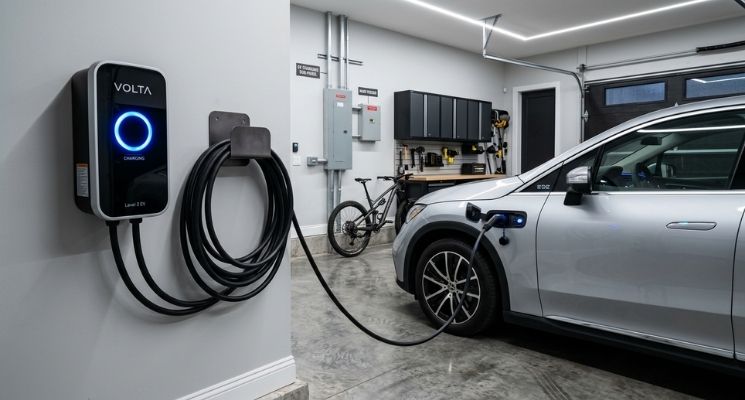
Choosing the right station is about balancing your current needs with your future dreams. If you’re looking for a “one and done” solution, a hardwired 40-amp or 48-amp smart charger is the gold standard. It provides enough speed for any future vehicle and gives you the data tracking to see exactly how much you’re saving compared to gas. But if you’re on a budget, a sturdy 32-amp “dumb” charger will still get you to 100% every single morning without a hitch.
We recommend checking out a detailed EV home charger review for specific models like the Emporia (best value), the Tesla Universal Wall Connector (best for mixed-brand households), or the Grizzl-E (best for extreme climates). The “best” charger isn’t the one with the most features; it’s the one that fits your electrical panel and your daily routine. Once that Level 2 station is humming along in your garage, you’ll truly understand why EV owners never want to go back to the pump.
Are you ready to upgrade? Have you looked at your electrical panel yet to see if you have room for a new double-pole breaker? If you have questions about specific brands or installation hurdles, drop a comment below! We’ve seen it all, from 100-year-old panels to ultra-modern smart homes, and we’re here to help you get plugged in safely.
FAQ
Can I install a Level 2 charger myself?
Unless you are a licensed electrician, we strongly recommend against it. Dealing with 240V and 50 amps of continuous current is dangerous. One loose wire can lead to an electrical fire. Always hire a pro and ensure they pull a permit.
Does it matter if the charger is NACS or J1772?
The industry is moving toward NACS (the Tesla plug). However, most chargers now offer “Universal” versions or cheap adapters. If you buy a J1772 charger today, you can easily use it with a NACS car via a $50 adapter, so don’t let the plug type stress you out too much.
How much does installation usually cost?
If your panel is in the garage, it might cost
600. If the electrician has to run wire across the entire house or upgrade your panel, it can easily jump to
3,000. Always get at least three quotes.
Will a Level 2 charger increase my electric bill?
Yes, but significantly less than you were spending on gas. On average, driving an EV is like paying $1.00 to $1.50 per gallon of gas. To save more, use your charger’s “Smart” features to only charge during “Off-Peak” hours when rates are lowest.

3 Comments on “Stop Trickle Charging | The No-Nonsense Guide to Picking a Level 2 Home Station”
Comments are closed.