We have all felt that sinking feeling at the local car dealership lately. You walk in, eyes set on a rugged, luxurious SUV, only to realize the monthly payment resembles a mortgage on a small island. It is frustrating to see premium design locked behind a six-figure paywall. Enter the ‘Temu Range Rover’: what the bestselling Jaecoo 7 says about China’s electric car ascendancy. This vehicle isn’t just a budget alternative; it’s a loud, metallic signal that the global automotive hierarchy is being dismantled in real-time.
The Aesthetic Arbitrage: Why the ‘Temu’ Label Sticks
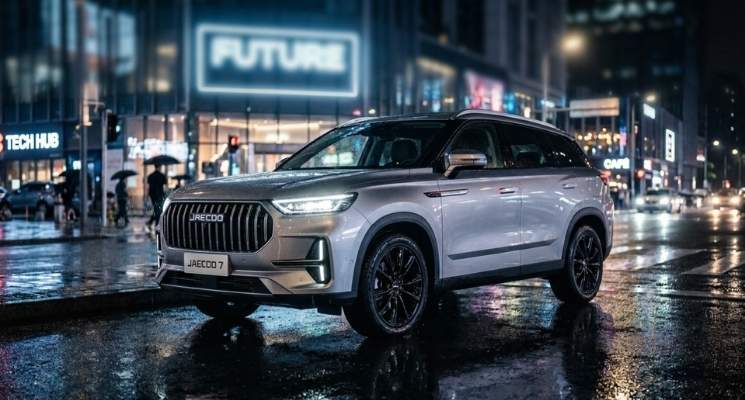
The nickname “Temu Range Rover” didn’t emerge from a vacuum. It captures the modern zeitgeist of “luxe-for-less.” When you first spot a Jaecoo 7 on the road, your brain does a double-take. The floating roof, the flush door handles, and that commanding, vertical grille all scream Solihull, yet the price tag whispers something entirely different. It’s an exercise in aesthetic continuity for a fraction of the cost.
But calling it “Temu” isn’t necessarily a slur in 2024. It represents a shift in consumer psychology where we no longer feel the need to pay for the “legacy tax” of European brands. We want the look, we want the presence, and we want the tech—without the heritage-inflated invoice. The Jaecoo 7 delivers exactly that, proving that China has mastered the art of “perceived value.”
Expert insights suggest this design strategy is intentional. By mimicking the visual language of established luxury, Chinese manufacturers like Chery (the parent of Jaecoo) bypass the decades-long process of building brand prestige. They are essentially hacking the consumer’s brain. If it looks like a Range Rover and feels like a Range Rover in the cabin, for many buyers, it is a Range Rover.
Engineering the Disruption: More Than Just a Pretty Face
If the Jaecoo 7 were merely a fiberglass shell on a rickety chassis, the hype would have died months ago. Instead, it has become a bestseller because the substance matches the style. Underneath that “Temu Range Rover” exterior lies a sophisticated powertrain that challenges the notion that Chinese cars are “cheap” in quality. The integration of advanced driver-assistance systems (ADAS) and a cockpit that rivals high-end smartphones is a testament to China’s electric car ascendancy.
We see a level of vertical integration here that Western manufacturers struggle to match. Because China controls the vast majority of the global battery supply chain, they can afford to pack their cars with high-density cells and rapid-charging tech while keeping the MSRP low. The Jaecoo 7 isn’t just a car; it’s a rolling showcase of manufacturing efficiency. It’s the result of a decade of aggressive R&D and state-backed industrial scaling.
From a mechanical perspective, the “All Road Drive Intelligent System” (ARDIS) in the Jaecoo 7 is surprisingly capable. It isn’t just for show. We’ve seen these vehicles navigate terrain that would make a standard crossover shudder. This capability is crucial. It tells the world that China isn’t just building city commuters anymore; they are building lifestyle vehicles that can compete with the legends of the off-road world.
The Geopolitical Shift: Breaking the European Hegemony
For nearly a century, the automotive world had a clear Pecking order. Germany owned engineering, Italy owned passion, and the UK owned rugged luxury. That order is now in shambles. The ‘Temu Range Rover’: what the bestselling Jaecoo 7 says about China’s electric car ascendancy is a direct threat to the economic stability of legacy European automakers. When a Chinese SUV can offer 90% of the experience for 40% of the price, the “legacy” argument begins to fail.
We are witnessing a “Great Transition.” European manufacturers are bogged down by high labor costs, energy crises, and a slow pivot to electrification. Meanwhile, Chinese brands are agile. They iterate on software every few months, not every few years. This speed of innovation is what allows a brand like Jaecoo to go from a PowerPoint presentation to a global bestseller in what feels like the blink of an eye.
Consider the hypothetical example of a mid-career professional in Sydney or Johannesburg. They could buy a used Discovery with 80,000 miles and a looming repair bill, or a brand-new Jaecoo 7 with a 7-year warranty and “new car smell.” For the pragmatic buyer, the choice is increasingly obvious. This shift in consumer behavior is draining the lifeblood out of traditional mid-tier luxury markets, forcing legacy brands to either go ultra-premium or face extinction.
The Buyer’s Reality: Is the Hype Justified?
You might be asking: “What’s the catch?” It’s a fair question. When something seems too good to be true, we look for the cracks. With the Jaecoo 7, the concerns usually center on long-term depreciation and parts availability. Since the brand is a newcomer, we don’t have twenty years of data on how these frames hold up against corrosion or how the software behaves after a decade of updates.
However, the “Expert Perspective” here is to look at the warranty structures. Jaecoo is offering aggressive support packages because they know they have to earn your trust. If you are someone who trades in your vehicle every 4 to 5 years, the depreciation curve matters less than the daily experience and the monthly savings. We suggest focusing on the “total cost of ownership” rather than just the sticker price.
Our advice? Don’t let the “Temu” nickname fool you into thinking this is a disposable product. It is a calculated, well-built machine designed to dominate a specific market segment. If you value cutting-edge infotainment and a commanding road presence over a badge that was famous in the 1970s, this vehicle is likely on your radar for a reason. The ascendancy isn’t coming; it’s parked in your neighbor’s driveway.
Redefining Luxury in the Electric Era
The success of the Jaecoo 7 forces us to redefine what “luxury” actually means in the 21st century. Is it a handcrafted leather seat from a factory in Crewe? Or is it a car that perfectly integrates with your digital life, offers zero-emission driving, and doesn’t bankrupt you? The ‘Temu Range Rover’: what the bestselling Jaecoo 7 says about China’s electric car ascendancy suggests that luxury is becoming democratized.
We are entering an era of “Functional Opulence.” The prestige is moving away from the emblem on the hood and toward the capability of the software inside. As China continues to lead the EV revolution, we can expect more brands like Jaecoo to challenge our preconceptions. They are proving that you can have your cake and eat it too—provided you are willing to look East.
The automotive landscape is changing faster than ever. Whether you view this as a threat to local industry or a win for the average consumer, one thing is certain: the era of overpriced, under-specced SUVs is drawing to a close. China has found the formula, and they are applying it with ruthless efficiency across the globe.
Final Thoughts: A New Road Ahead
The rise of the Jaecoo 7 is more than just a success story for a single brand. It is a blueprint for the future of the industry. We are seeing a world where quality and price are finally decoupled, allowing more people to experience high-end design. It’s an exciting, if slightly chaotic, time to be a car buyer.
Are you ready to trade prestige for practicality, or does the legacy of the old guard still hold sway over your heart? We want to hear your thoughts on the “Temu Range Rover” phenomenon. Drop a comment below and let’s discuss if China has truly won the EV race.
Stay ahead of the automotive curve. [Sign up for our newsletter] for weekly breakdowns of the tech and trends moving the world!
FAQ
Why do people call it the “Temu Range Rover”?
It’s a nickname born from its striking visual similarity to Land Rover products combined with a much lower price point, echoing the “high-end look for less” philosophy associated with the e-commerce giant Temu.
Is the Jaecoo 7 fully electric?
While the Jaecoo brand is a major player in China’s electric car ascendancy, the Jaecoo 7 is often offered in various configurations, including highly efficient Plug-in Hybrid (PHEV) and Internal Combustion Engine (ICE) versions, depending on the specific market.
How reliable are Chinese cars like the Jaecoo?
Modern Chinese brands like Chery/Jaecoo have invested billions in quality control and global testing. While they lack the long-term history of brands like Toyota, their generous warranties and high-tech manufacturing processes suggest they are built to compete with the best in the world.
Where can I buy a Jaecoo 7?
Jaecoo is rapidly expanding its footprint across Europe, South Africa, Australia, and Southeast Asia. Check your local automotive listings, as they are establishing new dealership networks every month to support their global push.