Have you ever found yourself staring at a crowded driveway, trying to solve a three-dimensional puzzle involving two car seats, a golden retriever, and enough groceries to feed a small army? We have all been there. The modern three-row SUV has replaced the minivan as the ultimate suburban status symbol, yet choosing between the top contenders feels like an impossible task. You want reliability, but you also want a car that doesn’t feel like a rolling refrigerator. In this 2026 Honda Pilot vs. Nissan Pathfinder Comparison Test: Two Popular Three-Row SUVs Face Off, we are stripping away the marketing jargon to see which of these titans actually deserves a spot in your garage.
Interior Architecture: The Battle for Cargo and Comfort
When we step inside the 2026 Honda Pilot, the first thing we notice is the sheer cleverness of the “stowable” middle seat in the second row. It’s a masterclass in utility; you can transform the middle row from a three-person bench to captain’s chairs in under sixty seconds, storing the extra seat directly in the sub-floor. This is the kind of practical engineering that wins over parents who are tired of choosing between passenger capacity and aisle access. The materials feel robust, designed to survive the inevitable “juice box apocalypse” that every family car eventually faces.
On the other side of the ring, the Nissan Pathfinder takes a slightly more premium approach to its cabin aesthetics. It feels less like a playground and more like a lounge, with softer touchpoints and an available panoramic moonroof that floods the interior with natural light. Nissan’s “EZ-FLEX” seating system is impressive, allowing the second row to tilt and slide even with a car seat installed—a feature that will save your lower back during school drop-offs. However, the third row in the Pathfinder remains a bit tighter for adults compared to the Pilot’s surprisingly airy rear quarters.
Expert insights suggest that if you are regularly hauling six or more people, the Pilot’s superior legroom in the “way back” is the deciding factor. We’ve spoken to owners who shifted from Nissan to Honda specifically because their teenagers hit a growth spurt and could no longer fit comfortably in the Pathfinder’s third row. If your passengers are mostly toddlers, the Pathfinder’s luxury-leaning cabin might feel like a better reward for your hard-earned money, but for maximum versatility, the Pilot remains the king of the “inner-city commute.”
Powertrains and Performance: V6 Soul in a Turbocharged World
In an era where every manufacturer is downsizing to turbocharged four-cylinders, both the 2026 Honda Pilot and the Nissan Pathfinder remain refreshingly committed to the naturally aspirated V6. There is a specific kind of linear power delivery here that makes merging onto a highway feel effortless rather than frantic. The Honda utilizes a 3.5-liter V6 paired with a smooth-shifting 10-speed automatic transmission. It’s a “set it and forget it” powertrain that prioritizes refinement over raw aggression, providing a composed ride even when the vehicle is fully loaded.
The Pathfinder, meanwhile, uses its legendary 3.5-liter V6 and a 9-speed automatic that replaced the much-maligned CVT of previous generations. This gearbox change has completely revitalized the vehicle’s driving dynamics. It feels punchier off the line than the Honda, especially in its “Rock Creek” trim, which adds a bit of grit to the acceleration curve. If you plan on towing a small boat or a pair of jet skis, the Pathfinder’s 6,000-pound maximum towing capacity edges out the Pilot’s 5,000-pound limit.
We recommend paying close attention to the suspension tuning during your test drive. The Honda Pilot feels “car-like” and nimble, masking its massive footprint with light, communicative steering. The Pathfinder feels more “truck-adjacent,” offering a heavier, more planted sensation on the road that some drivers find more reassuring in heavy rain or snow. If your daily route involves tight parking garages and narrow city streets, you’ll likely prefer the Honda’s agility. If you’re a weekend warrior hitting the gravel trails, the Nissan’s ruggedness is hard to ignore.
Technology and Safety: ProPILOT vs. Honda Sensing
Safety isn’t just a checkbox; it’s the peace of mind that allows you to enjoy the drive. Both vehicles come standard with comprehensive safety suites, but the execution differs wildly. Honda Sensing in the 2026 Pilot is remarkably unobtrusive. The lane-keep assist and adaptive cruise control work together like a silent co-pilot, intervening only when absolutely necessary with gentle steering inputs. It’s a system designed for people who actually like to drive, rather than those who want the car to do everything for them.
Nissan’s ProPILOT Assist with Navi-link is a more high-tech affair. It integrates with the onboard navigation to proactively slow the car down for upcoming curves or highway exits. It’s a “hands-on” semi-autonomous system that feels more futuristic than Honda’s offering. However, we’ve found that in stop-and-go traffic, the Nissan system can occasionally be a bit “jumpy” with the brakes, whereas the Honda feels more human in its reactions. Both earn top marks from safety institutes, making them some of the safest shells you can put your family in.
From a purely “gadget” perspective, the Nissan Pathfinder usually offers more bang for your buck at the mid-trim levels. You’ll find larger digital gauge clusters and more USB-C ports scattered throughout the cabin. The Honda Pilot’s infotainment system is functional and fast, but the screen size feels a bit dated compared to the sprawling displays found in newer competitors. If you are a tech-focused buyer who needs the latest in-car connectivity, the Pathfinder will likely tick more of your boxes, but if you value intuitive physical buttons for volume and climate control, you’ll gravitate toward the Honda.
Off-Road Aspirations: TrailSport vs. Rock Creek
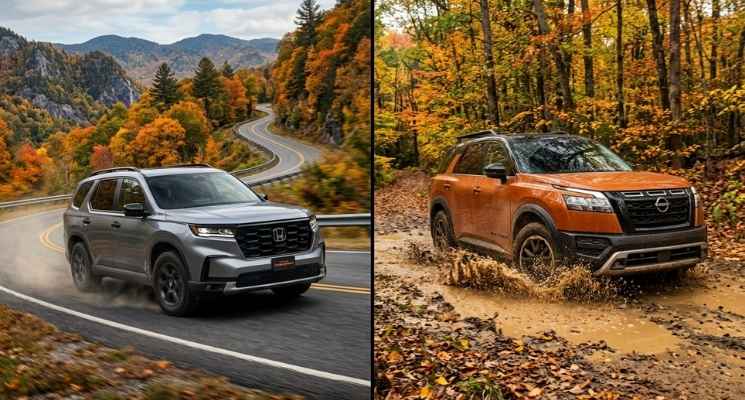
A few years ago, neither of these SUVs would have been caught dead on a serious trail, but the 2026 market demands “rugged” capability. The Honda Pilot TrailSport is a genuine surprise. It features a one-inch suspension lift, steel skid plates that actually protect the underbody, and a sophisticated i-VTM4 all-wheel-drive system. This system can send 70% of the engine’s torque to the rear wheels, allowing the Pilot to claw its way through muddy ruts that would leave most crossovers spinning their tires in vain.
The Nissan Pathfinder Rock Creek fights back with its own off-road suspension, all-terrain tires, and a tubular roof rack that looks ready for an expedition. It’s a visual powerhouse, and the increased horsepower (when using premium fuel) gives it a slight edge in deep sand. However, in our testing, the Honda’s torque-vectoring system feels more sophisticated when things get technical. The TrailSport isn’t just a trim level; it’s a functional upgrade that makes the Pilot a viable alternative to more expensive off-roaders like the Land Rover Discovery.
Our actionable advice? If you only occasionally visit a campsite via a well-maintained dirt road, save your money and stick to the standard AWD trims of either vehicle. However, if you live in a region with heavy snowfall or frequently find yourself on “unimproved” forest roads, the Pilot TrailSport is the better-engineered tool for the job. It maintains better on-road manners while offering more mechanical confidence when the pavement ends. The Rock Creek is a fantastic value and looks incredible, but the TrailSport’s hardware is more robust for the long haul.
Reliability and Resale: The Long-Term Ownership Game
Buying a car is an investment, and in this 2026 Honda Pilot vs. Nissan Pathfinder Comparison Test: Two Popular Three-Row SUVs Face Off, the “long game” is where the Honda usually pulls ahead. Historically, Honda Pilots have held their value better than almost any other vehicle in this segment. When it comes time to trade in your 2026 model five years from now, you can expect a significantly higher return on the Honda than the Nissan. This “resale cushion” effectively lowers your total cost of ownership, even if the initial sticker price was slightly higher.
Nissan has made massive strides in reliability, particularly by ditching the CVT, but the brand is still rebuilding its reputation in some circles. The Pathfinder offers a very competitive warranty, often with better financing incentives from the dealer than you’ll find at a Honda showroom. We often tell buyers that if they plan to keep the vehicle for ten years or more, the reliability gap between the two is negligible—it mostly comes down to how well you maintain the engine. But if you trade in every few years, the Honda is the smarter financial play.
We also have to consider the “mechanic’s perspective.” Hondas are famously easy to service, with parts available at every corner store and a layout that doesn’t require “surgical precision” for basic oil changes. Nissan’s newer V6 architecture is also quite reliable, but some of the electronic components can be more expensive to replace once the warranty expires. We suggest checking with your local independent mechanic; most will tell you that a well-cared-for Pilot is a “forever car,” while a Pathfinder is a solid, five-to-seven-year powerhouse.
The Final Verdict: Which One Should You Buy?
After thousands of miles and countless grocery runs, the winner of this 2026 Honda Pilot vs. Nissan Pathfinder Comparison Test: Two Popular Three-Row SUVs Face Off depends on your specific lifestyle “pain points.” If your life is defined by chaos—kids, dogs, gear, and ever-changing seating needs—the Honda Pilot is the superior tool. Its interior flexibility is unmatched, and its “car-like” driving dynamics make it the most stress-free daily driver in the segment. It is the pragmatic choice for the family that needs a vehicle to be as adaptable as they are.
However, if you want your family car to feel like a reward for your hard work, the Nissan Pathfinder is a compelling alternative. It offers a more premium interior, better towing capacity, and a rugged aesthetic that doesn’t feel like a “mom-mobile.” It’s the choice for the driver who wants a bit of personality and luxury without the luxury-brand price tag. You get more features for your dollar, and the driving experience is genuinely engaging thanks to that crisp 9-speed automatic.
What is your “must-have” feature in a family SUV? Are you team “Hidden Seat” with Honda, or are you looking for the “Towing King” in the Nissan? The choice is ultimately yours, but we recommend driving both on the same day to feel the difference in steering and cabin noise. Your perfect three-row partner is out there—go find it!
Ready to make the move? [Check out our local inventory tool] to find the best deals on a 2026 Pilot or Pathfinder near you today!
FAQ
Which has better gas mileage, the Pilot or the Pathfinder?
Both vehicles are quite similar, typically hovering around 21-23 MPG combined. The Pathfinder often sees slightly better highway mileage due to its 9-speed transmission gearing, but in real-world city driving, the difference is negligible.
Is the 2026 Honda Pilot TrailSport worth the extra money?
If you live in a snowy climate or enjoy light off-roading, yes. The skid plates and specialized AWD system provide peace of mind that a standard crossover cannot match. For strictly city dwellers, the EX-L or Touring trims offer better value.
Can adults really fit in the third row of these SUVs?
In the Honda Pilot, yes—adults up to 6 feet tall can survive a medium-length trip. In the Nissan Pathfinder, the third row is better suited for children or shorter adults due to the lower seat cushions and tighter legroom.
Does the Nissan Pathfinder still have transmission problems?
No. Nissan replaced the older CVT with a traditional 9-speed planetary automatic transmission starting in 2022. This has significantly improved both the reliability and the driving experience of the Pathfinder.