
You’ve been there—cruising at 70 mph on a rain-slicked highway when your navigation suddenly freezes, leaving you guessing which exit to take. It is the ultimate modern driving frustration. We buy these high-tech machines, yet the “smart” interface often feels like it belongs in 2010. You want a car that syncs with your life, not one that requires a degree in computer science just to change the radio station.
The battlefield for your dashboard has shifted dramatically as we enter the 2026 model year. Car tech reviews used to focus on horsepower and torque, but now, the processor under the screen is just as vital. We are seeing a massive divide in the industry: some manufacturers are handing the keys entirely to Big Tech, while others are desperately trying to build their own “walled gardens.” It is a confusing time to buy a new vehicle if you value seamless connectivity.
Let’s tear down the current state of the best infotainment systems. We have spent hundreds of hours behind the wheel of the latest releases to see who actually wins the battle for your attention. This isn’t just about icons on a screen; it is about how you interact with your vehicle every single day.
The Next-Gen Apple CarPlay: Total Vehicle Takeover
Apple is no longer content with just being a “window” on your dashboard. With the rollout of “Next-Gen CarPlay” in late 2025 and 2026 models, the software now reaches into your gauge cluster, your fuel levels, and even your climate control. It is a total aesthetic takeover. We’ve noticed that for iPhone users, this creates a level of visual cohesion that was previously impossible. Your car’s speedometer can now match the font and color scheme of your lock screen.
However, there is a catch that we need to talk about. To get this level of integration, car manufacturers have to give Apple unprecedented access to the vehicle’s “brain.” Some brands, like Porsche and Aston Martin, have leaned in, offering a breathtakingly smooth experience. But others are hesitant. When you are looking at Apple CarPlay vs Android Auto, the Apple side now offers a more “premium” feel, but only if you choose a vehicle brand that hasn’t blocked these deeper features.
Our expert insight is simple: if you are an iPhone user, check if the 2026 model you are eyeing supports “multi-screen” CarPlay. If it only supports the old-school single-window version, you are missing out on the primary reason to stay in the ecosystem. The ability to see your Apple Maps topography directly behind the steering wheel is a game-changer for long-distance touring. It reduces eye strain and keeps your focus where it belongs—on the road.
Android Auto and the Rise of Google Built-In
Google has taken a fundamentally different path, and in many ways, it is the more powerful one. While Apple focuses on “mirroring” your phone, Google is increasingly living inside the car’s hardware. This is known as Google Built-in (or Android Automotive OS). In our recent car tech reviews, we found that systems from Volvo, GM, and Polestar are incredibly snappy because they don’t rely on a wireless connection to your phone to function.
The “Best Infotainment Systems” in 2026 often use Google as the foundation because it allows for native Spotify and Google Maps apps that run even if your phone is dead. The voice command capability here is significantly ahead of Siri. You can say, “Hey Google, I’m feeling cold,” and the car adjusts the actual HVAC vents, not just a digital slider. It is a level of utility that feels like the car is finally working with you rather than against you.
We’ve found that Android Auto (the phone-mirroring version) has also received a massive stability update for 2026. The “Coolwalk” interface has matured, allowing for better split-screen multitasking. If you are a heavy user of Google Workspace or specialized delivery apps, the Android ecosystem generally offers more flexibility. It doesn’t look as “boutique” as Apple’s new interface, but from a pure productivity standpoint, it is hard to beat.
The Latency Test: Wireless vs. Wired in 2026
One of the biggest pain points we hear from drivers is connection lag. There is nothing worse than clicking “Next Track” and waiting two seconds for the music to change. In our testing of 2026 models, we’ve seen a significant jump in wireless stability thanks to Wi-Fi 7 integration in premium head units. However, the “Apple CarPlay vs Android Auto” debate often comes down to how your specific phone handles the heat generated by wireless projection.
I recently took a 2026 luxury SUV on a four-hour road trip using wireless CarPlay. Halfway through, my iPhone overheated because it was simultaneously running GPS, streaming high-res audio, and sitting on a wireless charging pad. This is the “hidden” downside of the wireless revolution. Our actionable advice? Even if your car supports wireless, always keep a high-quality USB-C cable in the center console for long trips. It saves your battery and keeps the system responsive.
Furthermore, we are seeing a trend where the best infotainment systems are moving toward “High-Bitrate” audio over wired connections. If you have an optional 20-speaker sound system, using a wireless connection is like drinking a fine wine through a straw. You are compressing the audio data. For the true audiophiles out there, the “wired” experience in 2026 is the only way to truly hear what your car’s premium audio system is capable of.
The Great GM Divorce: Life Without Phone Mirroring
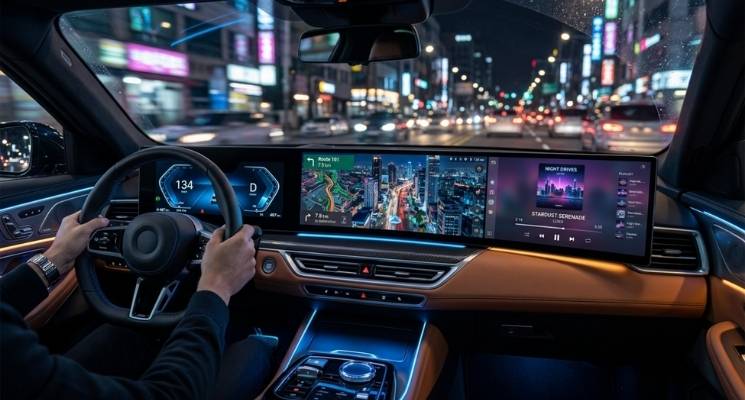
We cannot discuss 2026 car tech without mentioning the “Elephant in the Room.” General Motors (Chevrolet, GMC, Cadillac) has famously ditched both Apple CarPlay and Android Auto in their new electric vehicles. They want you to use their native, subscription-based Google system. This has caused a massive stir in the enthusiast community. We have tested these “native-only” systems, and while they are fast, they lack the “personality” of your own phone.
Our perspective is that this is a risky move for manufacturers. You’ve spent years curating your playlists, your saved locations, and your podcast subscriptions. Forcing you to log into a car’s dashboard to access those things feels like a step backward. When reading car tech reviews this year, pay close attention to the “Connectivity” section. If a car doesn’t support phone mirroring, you are essentially locked into whatever software updates the manufacturer decides to provide—or stop providing—five years down the line.
Hypothetically, imagine trying to sell a used car in 2031 where the native “Smart” system no longer supports the latest version of Spotify. If that car has CarPlay, it doesn’t matter, because your phone provides the brains. If it doesn’t, that dashboard becomes a very expensive paperweight. We strongly recommend prioritizing vehicles that offer the choice of using your phone’s ecosystem. Flexibility is the ultimate luxury.
Future-Proofing Your Purchase: What to Look For
So, which one should you choose? The reality is that the “Apple CarPlay vs Android Auto” choice is usually made the moment you buy your smartphone. Very few people switch phones just for their car. However, you can choose a car that handles your phone better. Look for vehicles with “Over-The-Air” (OTA) update capabilities for the infotainment system itself. This ensures that as Apple and Google update their software, your car can actually handle the new features.
Also, don’t ignore the physical controls. The most innovative apps in the world are useless if you have to dig through three menus just to turn down the volume. We’ve found that the best infotainment systems in 2026 are the ones that balance a massive screen with physical “hotkeys” for essential functions. It is about safety as much as it is about technology.
Take a test drive and spend at least 15 minutes just playing with the screen before you even put the car in gear. Connect your phone, run a navigation route, and try to make a phone call. If the system feels clunky in the showroom, it will be infuriating on your morning commute. Your car is the most expensive accessory your phone will ever have—make sure they get along.
FAQ
Which is better for navigation: Apple CarPlay or Android Auto?
In 2026, Android Auto still holds a slight edge due to the deep integration of Google Maps and its superior handling of real-time traffic data and “offline” maps. However, Apple Maps has narrowed the gap significantly with its new “Next-Gen” 3D city views and better integration with EV charging stops.
Can I use both Apple CarPlay and Android Auto in the same car?
Most 2026 vehicles are “agnostic,” meaning they support both. The system will detect which phone is plugged in or connected via Bluetooth and launch the appropriate interface. However, some brands (like GM’s new EVs) have started to block both in favor of built-in systems.
Does using CarPlay or Android Auto use my phone’s data?
Yes. Both systems essentially “project” apps from your phone onto the car’s screen. Any data used for streaming music or navigation comes from your phone’s data plan unless the car has its own active Wi-Fi hotspot that your phone is connected to.
Is wireless CarPlay better than a wired connection?
Wireless is more convenient for short trips, but a wired connection is superior for long drives. Wired connections provide higher audio quality, zero lag, and prevent your phone from overheating while charging.

5 Comments on “The Dashboard War | Is Apple CarPlay Still King, or Has Android Auto Taken the 2026 Crown?”
Comments are closed.