Have you ever stood on a street corner in San Francisco or Los Angeles, watching a driverless car freeze at a green light or block an ambulance, and wondered who is actually in charge? For years, these high-tech marvels navigated a legal “no-man’s land” where they were essentially immune to the traffic tickets we humans dread. That era of digital immunity is officially grinding to a halt as California updates its playbook for the autonomous age.
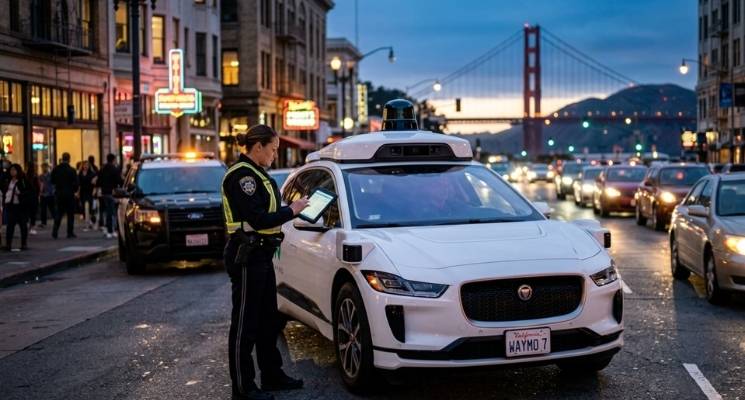
The frustration among local law enforcement has been palpable for a long time. Imagine being a patrol officer and witnessing a vehicle blow through a stop sign, only to realize there isn’t a human inside to hand a citation to. It felt like the Wild West of tech, where the “move fast and break things” mantra finally met the reality of public safety.
Now, we are seeing a pivotal shift in how the California DMV and state legislature view these autonomous fleets. It’s no longer just about fostering innovation at any cost. It’s about ensuring that if a computer makes a mistake that would cost you $300 and a point on your license, the company behind that computer pays a similar price.
Closing the Ghost-Driver Loophole
For the longest time, California’s vehicle code was written with a fatal assumption: that every vehicle has a human driver. This loophole allowed companies like Waymo and Cruise to operate with a degree of legal frictionlessness that traditional taxi services could only dream of. If a robotaxi parked illegally or obstructed traffic, police often found their hands tied because they couldn’t “identify” a driver to cite.
Recent legislative updates, specifically those targeting the operational permits of autonomous vehicle (AV) companies, are changing the game. Law enforcement agencies are now gaining the authority to issue electronic citations directly to the companies owning the fleet. This means the ticket follows the VIN and the corporate entity, rather than a non-existent human operator.
Think of it as a corporate accountability measure that finally catches up with Silicon Valley’s ambition. We are moving toward a system where the “driver” is the software, and the software’s “parents”—the tech giants—are the ones who will have to open their checkbooks. This isn’t just about revenue; it’s about creating a feedback loop that forces these companies to prioritize safety over rapid expansion.
How Cops “Pull Over” a Computer
You might be wondering: how does a police officer actually initiate a traffic stop with a car that doesn’t have ears or a steering wheel? It’s a surreal scene that is becoming more common on California streets. Most AV companies have established “law enforcement interaction protocols” that allow officers to trigger a stop through digital signals or by contacting a remote assistance center.
Expert insight suggests that the next generation of police cruisers will likely be equipped with direct-link communication tools. This would allow an officer to send a “stop” command directly to the vehicle’s operating system. Once the vehicle is safely pulled over, the officer interacts with a remote representative via the car’s internal communication system to document the violation.
I’ve spoken with tech consultants who believe this will lead to “automated ticketing” where the car’s own telemetry data is used against it. Imagine the irony: the car’s internal sensors record a lane violation, and that data is automatically beamed to a police server. It’s a high-tech version of the dashcam, but the witness is the car itself.
The Impact on Insurance and Liability
This shift isn’t just bad news for the tech companies; it’s a massive win for the insurance and legal industries. When police start ticketing driverless cars, they create a paper trail of “fault.” This is crucial for high-stakes litigation and determining who pays when a robotaxi clips a cyclist or side-swipes a parked car.
For you, the everyday driver, this could eventually lead to more predictable insurance premiums. As these companies accumulate citations, their risk profiles become clearer. We might see a world where autonomous vehicle liability insurance becomes one of the most profitable sectors in the tech-legal space.
We have to consider the “Personal Example” scenario: if a robotaxi hits your car today, your lawyer needs proof of negligence. A police-issued citation for a traffic violation is the “smoking gun” needed to win a settlement. Without these tickets, victims were often left in a “he-said, robot-said” situation that favored the deep pockets of big tech.
Why This Matters for the Future of Urban Transit
Some critics argue that ticketing these vehicles will slow down the adoption of life-saving technology. They claim that humans are far more dangerous drivers and that we should give the AI room to learn. However, public trust is the most valuable currency in the autonomous car industry, and right now, that trust is at an all-time low in cities like San Francisco.
By holding these vehicles to the same standards as us, we are actually legitimizing them. If they can follow the law well enough to avoid tickets, the public will feel much safer sharing the road with them. It forces the developers to refine their “edge case” logic—those tricky situations where the car doesn’t quite know what to do at a complex intersection.
In the long run, this oversight will lead to smarter, more cautious AI. We aren’t just punishing the companies; we are coaching the algorithms. The road to a fully autonomous future is paved with regulations, and California is currently laying the first few bricks.
FAQ
Can I sue a driverless car company if it gets a ticket for hitting me?
Absolutely. A police citation serves as official documentation of a traffic violation, which is a powerful piece of evidence in any personal injury or property damage claim against the AV operator.
Who pays the fine for a driverless car ticket?
The registered owner of the autonomous vehicle fleet—companies like Waymo, Zoox, or Cruise—is responsible for paying all fines and associated legal penalties.
Will these tickets result in “points” on a license?
Since there is no human driver, there is no personal driver’s license to assign points to. However, the DMV monitors the “safety record” of the company’s operating permit, which can be suspended if they accumulate too many violations.
Are police trained to handle “rogue” autonomous vehicles?
Yes, California law enforcement agencies are increasingly receiving specialized training on how to disable or move autonomous vehicles that become unresponsive or block emergency scenes.
Does this make autonomous cars safer?
Many experts believe it does. Financial penalties provide a direct incentive for companies to fix software bugs and improve the decision-making capabilities of their AI drivers.
The Road Ahead
The transition from human-led driving to AI-controlled fleets is the biggest shift in transportation since the horse and buggy. But technology shouldn’t be an excuse for lawlessness. California’s move to empower police is a necessary step in making our streets safer for everyone—whether you’re behind a wheel or sitting in the back of a “ghost car.”
If you’ve had a close call with a driverless car or just want to stay updated on the latest tech laws, make sure to subscribe to our newsletter. Let’s keep the conversation going—do you think these tickets are high enough to change corporate behavior?