
You’ve likely seen the headlines. The bold, stainless-steel silhouette of the Tesla Cybertruck dominating the landscape, promising a future of low-maintenance, high-performance driving. It’s the ultimate “spaceship” for the road. But what happens when you push that futuristic vision to the absolute limit? One Nashville-based owner decided to find out, putting his Cybertruck to work as a full-time Lyft rideshare vehicle, racking up a staggering 100,000 miles in just one year.
The result wasn’t just a successful experiment in high-mileage electric transport; it was a candid lesson in the hidden costs of early EV adoption. After 100,000 miles of city streets, highway hauls, and constant passenger turnover, the owner didn’t just face routine maintenance—he hit a $7,200 repair bill for a single component failure. For anyone considering the Cybertruck as a primary work tool or a high-mileage daily driver, this story is the most important “check engine” light you’ll ever see.
The Economics of a Rideshare “Spaceship”
Driving 100,000 miles in 12 months requires discipline that goes well beyond the average commuter’s routine. This owner treated the truck like a commercial asset, running long, 7.5-hour shifts day after day. It turns out, the Cybertruck is a massive hit with passengers. In a market flooded with the usual suspects—Priuses and Altimas—the novelty of a panoramic roof and a futuristic cabin makes for a premium ride experience.
But here is where the math gets complicated. While the owner saved thousands on fuel compared to a heavy-duty gas truck, those savings didn’t exist in a vacuum. By the time the odometer hit 100,000 miles, the reality of high-performance EV ownership set in. You aren’t just paying for electrons; you’re paying for the specialized upkeep of a machine that weighs nearly 7,000 pounds and pushes massive torque through its drivetrain.
The Component Failure That Stung
The real surprise came when the truck crossed the warranty threshold. The culprit? The Power Conversion System (PCS). After 60,000 miles of hard, consistent use, this critical high-voltage component failed, leading to a $7,200 repair bill. When you are outside the coverage window, Tesla’s service pricing is firm, and that single repair essentially wiped out a significant chunk of the fuel savings the owner had banked over the year.
This failure highlights a growing trend in high-mileage EV reports. While the “mechanical” aspects—like the lack of oil changes and brake pad replacements—are genuine wins for long-term owners, the “electronic” heart of the vehicle is where the financial risk lies. If you are budgeting for a Cybertruck, you cannot simply look at the sticker price or the fuel savings. You have to account for a “tech-readiness” fund for out-of-warranty electronic failures.
Tires and the “Heavy Truck” Tax
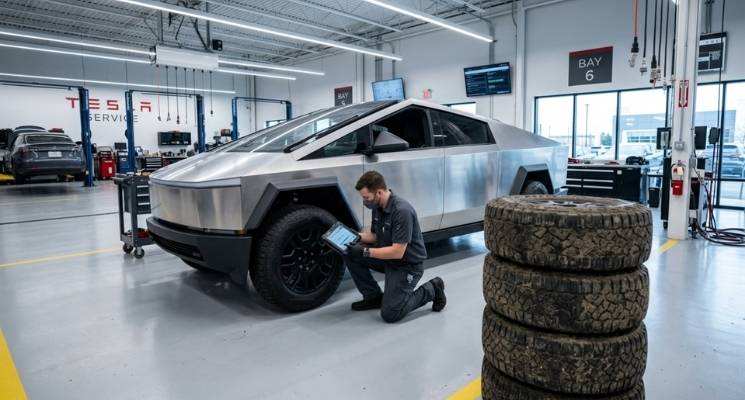
If the PCS failure was the headline, the tires were the daily grind. Running a 7,000-pound vehicle for 100,000 miles means you are going to burn through rubber. The owner replaced the original set around 40,000 miles, dropping $2,500 for high-quality tires designed to handle the weight and torque of an electric truck.
Expert insight is crucial here: do not try to “cheap out” on tires for an electric truck of this size. You need rubber that can handle the regenerative braking and the sheer force of acceleration. Factor in the cost of alignment and balanced sets, and you start to see that the “zero maintenance” narrative is a bit of a myth. You aren’t doing brake jobs, but you are absolutely doing tire rotations and replacements at an accelerated pace.
Balancing the Future: Is It Worth It?
So, is the Cybertruck a failure as a workhorse? Far from it. It survived 100,000 miles of grueling commercial use, blizzard conditions, and continuous charging without the drivetrain dying or the battery becoming a paperweight. Even with the $7,200 repair and the tire expenses, the owner reports that the total cost of ownership remains competitive with a traditional internal-combustion truck.
However, the margin is much tighter than the marketing might lead you to believe. If you depend on this vehicle for your livelihood, you need a contingency plan for when the electronics decide they’ve had enough. The Cybertruck is a pioneer, and pioneers often face the roughest terrain—both on the road and on the balance sheet.
FAQ
Is the Cybertruck really “maintenance-free”?
It eliminates oil changes and many traditional brake jobs, but it introduces new maintenance needs like specialized, high-load tires and potential high-cost electronic repairs for components like the Power Conversion System.
How does range degradation look after 100k miles?
The owner reported a drop from roughly 340 miles to 299 miles on a full charge—a roughly 12% reduction. For most, this is manageable, but it’s a factor for those who need maximum daily range.
Why are repair costs so high for the Cybertruck?
Because the vehicle uses proprietary components and complex integrated systems, repairs often require specialized labor at Tesla-approved centers, which limits your ability to “shop around” for lower-cost mechanics.
What’s your take? If you knew you’d face a $7,200 bill at 60,000 miles, would you still opt for the “spaceship” over a proven diesel workhorse? Let’s talk about it below.