
We’ve all stood there at the pump, watching the digits on the display climb higher than we’d like, wondering if there is a better way to navigate our daily lives without being tethered to the fluctuating price of crude oil. You want to go green, or at least “green-ish,” but the leap to a full Battery Electric Vehicle (BEV) feels like a bridge too far. Maybe you live in an apartment without a charger, or perhaps you just suffer from that nagging “range anxiety” that makes a cross-country trip in a Tesla feel like a logistical nightmare. This is exactly where the confusion between a standard Hybrid and a Plug-in Hybrid (PHEV) begins to bubble up.
It is easy to get lost in the alphabet soup of HEVs, PHEVs, and MHEVs. On the surface, they look identical; they both have an engine, they both have a battery, and they both promise to be among the most fuel-efficient cars on the market. But the way they interact with your lifestyle is fundamentally different. One is a “set it and forget it” machine that requires zero change in your habits, while the other is a gateway drug to the electric life that demands a nightly commitment to a charging cable. If you choose the wrong one, you’re either leaving thousands of dollars in fuel savings on the table or paying for a massive battery that you’re essentially just carrying around as dead weight.
In this comprehensive Hybrid vs PHEV comparison, we aren’t just going to look at the spec sheets. We are going to look at the psychological and practical realities of living with these machines. We’ll break down the “cost-per-mile” logic, the infrastructure hurdles, and highlight some of the best plug-in hybrids 2025 has to offer. By the time we’re done, you’ll know exactly which badge deserves a spot in your driveway and whether you’re truly ready to start “plugging in.”
The Mechanical Nuance: What’s Really Under the Hood?
Let’s start with the standard Hybrid (HEV), the technology pioneered by the legendary Toyota Prius. A standard hybrid is effectively a gas car with a very smart electric assistant. It has a small battery, usually around 1-2 kWh, that captures energy normally lost during braking—a process called regenerative braking. You never plug this car in. The electric motor helps the gas engine during acceleration and handles low-speed crawling in traffic. It’s an elegant, closed-loop system that boosts your MPG from the mid-20s to the high-50s without you ever having to think about it.
A Plug-in Hybrid (PHEV) is a different beast entirely. Think of it as a “split personality” vehicle. It has a much larger battery, often between 10 kWh and 20 kWh, and a much more powerful electric motor. This allows the car to drive entirely on electricity for a set distance—usually between 25 and 50 miles—at highway speeds. Once that battery is depleted, the car doesn’t stop; it simply switches over to act like a regular hybrid. This dual-nature makes it one of the most versatile fuel-efficient cars ever built, but it adds significant weight and complexity to the chassis.
The key takeaway here is the “port.” If there isn’t a flap on the side of the car for a charging cable, it’s a standard hybrid. In our Hybrid vs PHEV comparison, the PHEV represents a more proactive approach to efficiency. It gives you the “EV experience” for your daily commute while keeping the gas engine as a safety net for long-haul trips. However, if you don’t actually plug it in, you’re just driving a regular hybrid that is 500 pounds heavier due to the oversized battery, which actually makes it less efficient than a standard hybrid.
Expert Insight: The “Dead Weight” Trap
I’ve seen dozens of buyers opt for a PHEV because of the “cool factor,” only to realize three months later that they are too lazy to plug it in every night. If you don’t have a dedicated outlet in your garage or at your workplace, do not buy a PHEV. You will be lugging around an expensive, heavy battery that provides no benefit, and your fuel economy will actually be worse than if you had just bought the cheaper, lighter standard hybrid. Be honest with your habits before you sign the paperwork.
The Lifestyle Fit: Mapping Your Commute
To decide between these two, you need to pull up your Google Maps history. The “Magic Number” for a PHEV is your daily round-trip mileage. If you commute 15 miles to work and 15 miles back, a car like the Toyota RAV4 Prime or the Prius Prime could allow you to go months without ever burning a drop of gasoline. You are effectively driving an EV for 90% of your life. This is the ultimate “best of both worlds” scenario. You save a fortune on fuel, but you can still drive 600 miles to see family for the holidays without stopping for an hour to charge.
However, if your lifestyle involves a lot of “unstructured” driving—lots of long-distance sales calls, frequent 200-mile trips, or if you live in a rural area with zero charging infrastructure—the standard hybrid is the undisputed king. The HEV shines in stop-and-go city traffic and remains incredibly efficient on the highway without the need for any external input. It is the perfect tool for the person who wants to help the environment and their wallet but doesn’t want their car to feel like another “device” that needs to be managed and monitored.
We also have to consider the “Electric of Senses.” Driving a PHEV in EV mode is silent, torquey, and smooth. It gives you a taste of the future. A standard hybrid still feels like a gas car; you’ll hear the engine drone when you merge onto the highway. If you value the serenity of electric propulsion, the PHEV wins this round of the Hybrid vs PHEV comparison hands down. But remember, that serenity only lasts as long as the battery charge does. Once the gas engine kicks in on a PHEV, it often sounds more strained than a standard hybrid because it’s working harder to move that extra battery weight.
The Financial Reality: Entry Cost vs. Long-Term ROI
Money is where the rubber meets the road. In general, a PHEV will carry a price premium of $4,000 to $8,000 over its standard hybrid counterpart. That is a significant chunk of change. To justify that cost, you have to look at federal and state tax credits. In the US, many PHEVs qualify for a partial tax credit (though the rules are constantly changing based on where the battery is manufactured). If you can snag a $3,750 or $7,500 credit, the price gap between the Hybrid vs PHEV comparison almost disappears, making the PHEV an absolute “no-brainer.”
Then there is the “fuel vs. electrons” math. Depending on where you live, electricity is almost always cheaper than gasoline per mile. If you are diligent about plugging in your PHEV, you are “refueling” at a fraction of the cost of a standard hybrid. Over a five-year ownership period, a PHEV can save you thousands of dollars in operating costs, provided you are maximizing that all-electric range. If you drive 12,000 miles a year and 10,000 of those are on electricity, the ROI is massive.
But don’t overlook maintenance. A standard hybrid is a very mature, reliable technology with fewer components than a PHEV. While both are generally reliable, the PHEV has a more complex cooling system for its larger battery and a more sophisticated onboard charger. If you plan on keeping the car for 15 years and 250,000 miles, the simpler standard hybrid might be the safer bet for long-term “out of warranty” peace of mind. For those looking for the best plug-in hybrids 2025 offers, brands like Volvo and BMW are offering impressive warranties, but complexity always carries an inherent risk.
Actionable Advice: Check Your Utility Rates
Before buying a PHEV, call your electric company and ask if they have “Time-of-Use” (TOU) rates. Many utilities offer incredibly cheap electricity between midnight and 6:00 AM. If you can charge your PHEV for pennies during those hours, the financial argument for the plug-in becomes much stronger. Without a TOU plan, the savings might be slimmer than the marketing brochures suggest.
The 2025 Market Landscape: The Best of the Best
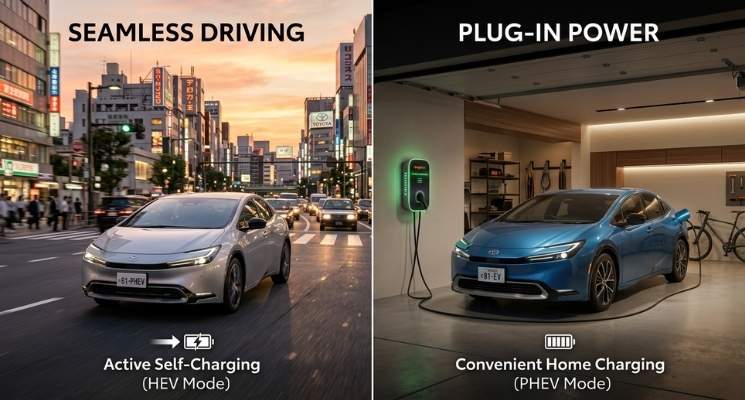
As we move into 2025, the options for fuel-efficient cars have exploded. Toyota remains the heavyweight champion in this arena. The Prius Prime is currently the gold standard for PHEVs, offering nearly 44 miles of electric range and stunning looks that finally shed the “geeky” Prius image. If you need an SUV, the RAV4 Prime is a powerhouse, offering 302 horsepower—making it the second-fastest car in Toyota’s lineup behind the Supra—while still delivering 42 miles of EV range.
On the luxury side, the best plug-in hybrids 2025 list includes the BMW X5 xDrive50e and the Volvo XC90 Recharge. These vehicles have shifted from “compliance cars” to truly impressive machines that offer 30-40 miles of range and world-class interiors. They are perfect for the executive who wants to commute silently during the week but needs a rugged, gas-powered SUV for weekend ski trips. The technology has matured to the point where the transition between gas and electric is now almost imperceptible.
For those on a budget, the standard hybrid market is still dominated by the Honda CR-V Hybrid and the Hyundai Tucson Hybrid. These cars offer a “normal” driving experience with fantastic fuel economy. They don’t require any lifestyle changes and provide a massive jump in MPG over the traditional gas versions of these SUVs. In our Hybrid vs PHEV comparison, these standard hybrids remain the most logical choice for the average American family who just wants a reliable, efficient car without the “homework” of charging.
Final Verdict: Which One Should You Buy?
At the end of the day, the choice between a Hybrid and a PHEV isn’t about which technology is “better”—it’s about which one fits the way you actually live. If you are a homeowner with a garage, a commute under 40 miles, and a desire to dip your toes into the electric lifestyle, the PHEV is a spectacular choice. It turns your daily drive into a silent, gas-free experience while retaining the freedom to drive anywhere at a moment’s notice. It’s the ultimate security blanket for the eco-conscious driver.
However, if you rent an apartment, have a long highway commute, or simply don’t want the hassle of another cable in your life, the standard hybrid is still a masterpiece of efficiency. It is the most “frictionless” way to lower your carbon footprint and save money at the pump. Don’t let the “EV hype” pressure you into a PHEV if you aren’t going to use its primary feature. A standard hybrid is a massive win for your wallet and the planet.
Where do you stand? Are you ready to commit to the nightly plug-in ritual for those “free” electric miles, or does the simplicity of a standard hybrid sound like a better fit for your busy schedule? Let us know in the comments below! We’d love to hear about your real-world MPG and whether your PHEV is actually living up to the hype.
FAQ
Can I drive a PHEV if the battery is dead?
Absolutely. A PHEV never truly has a “dead” battery; it always keeps a small reserve to act like a regular hybrid. You can drive it on gasoline indefinitely without ever plugging it in, though it’s not the most efficient way to use the car.
Do hybrids and PHEVs need special oil changes?
No. They use standard internal combustion engines. In fact, in a PHEV, you might go much longer between oil changes because the gas engine isn’t running as often. However, you should still follow the manufacturer’s time-based schedule.
How long do the batteries last?
Most manufacturers provide a 10-year/150,000-mile warranty on hybrid batteries. Modern liquid-cooled batteries are designed to last the life of the vehicle, often exceeding 200,000 miles with minimal degradation.
Is a PHEV faster than a regular hybrid?
Usually, yes. Because PHEVs have larger electric motors and batteries that can discharge more power quickly, they often have significantly higher horsepower and faster 0-60 mph times than their standard hybrid counterparts.

6 Comments on “The Great Efficiency Debate | Is a Hybrid or a PHEV the Real Gas-Killer for You?”
Comments are closed.