
If you manage a fleet or move freight for a living, you are currently staring down the barrel of a multi-billion dollar ultimatum. The pressure to “decarbonize” isn’t just a suggestion anymore; it is coming in the form of strict mandates, carbon taxes, and corporate ESG goals that feel like they were written by someone who has never actually sat in a cab for fourteen hours straight. The common pain point is obvious: you want to go green, but you can’t afford to let your trucks sit at a charging station for six hours while the competition is already three states away. It is a logistical nightmare where the promise of a “cleaner future” keeps crashing into the brick wall of operational reality.
Right now, the industry is split into two warring camps. On one side, we have the Battery Electric Vehicle (BEV) enthusiasts who point to the massive success of light-duty cars. On the other, a growing coalition is betting the farm on hydrogen fuel cell technology. This isn’t just about choosing a fuel source; it’s about a fundamental disagreement on the physics of moving 80,000 pounds across a continent. If we get this wrong, the supply chain as we know it could grind to a halt under the weight of its own batteries.
In this deep dive, we are going to look past the stock market hype. We will explore the “payload penalty,” the infrastructure gridlock, and the brutal math of H2 vs EV trucks. If you’ve ever wondered why some manufacturers are pouring billions into a gas that is famously difficult to store, you are about to find out. The future of green trucking isn’t going to be a “one size fits all” solution, and the winner of this race will likely be determined by the one thing logistics managers value most: uptime.
The Payload Penalty: Why Batteries are a Heavy Burden
Let’s talk about the dirty secret of electric semi-trucks: gravity is not their friend. To move a Class 8 truck 500 miles on a single charge, you need a battery pack that is essentially the size of a small car and weighs upwards of 10,000 to 15,000 pounds. In the trucking world, weight is literally money. Every pound of lithium-ion battery you bolt onto the chassis is a pound of cargo you can no longer legally carry. For a fleet moving high-density goods like beverages or construction materials, the “payload penalty” of an EV can slash profit margins by 10% to 20% overnight.
This is where hydrogen fuel cell technology starts to look like a miracle. A hydrogen system consists of high-pressure tanks, a fuel cell stack, and a much smaller buffer battery. This entire setup is significantly lighter than the massive battery arrays found in BEVs. We are talking about a weight savings that can be measured in tons. For a long-haul carrier, that extra capacity means more pallets per trip and fewer trucks on the road to move the same amount of freight. It’s an efficiency gain that batteries simply cannot match without a radical breakthrough in solid-state chemistry.
Think about the “opportunity cost” of your equipment. If your truck is limited by the weight of its own fuel system, you are essentially paying to transport dead weight. Hydrogen allows for a “gravimetric energy density” that mimics the benefits of diesel. You get the long range and the high payload without the environmental guilt. This single factor is why companies like Nikola, Hyundai, and Kenworth are doubling down on H2. In the high-stakes game of freight, the lightest truck often wins the most contracts.
The 15-Minute Revolution: Uptime and Refueling Reality
Time is the only currency that truly matters in logistics. When a diesel driver pulls into a truck stop, they are back on the road in 15 to 20 minutes with another 1,000 miles of range in the tank. To achieve that same throughput with a battery-electric truck, you would need a charging station with the power draw of a medium-sized city. Even with the “Megawatt Charging System” (MCS) currently in development, we are still looking at 45 to 90 minutes for a meaningful top-off. That is time stolen from the driver’s hours-of-service and a massive blow to the “turn-and-burn” efficiency of modern fleets.
In the H2 vs EV trucks debate, hydrogen’s greatest weapon is the pump. Refueling a hydrogen truck feels exactly like refueling a diesel one. You pull up, click the nozzle into place, and the high-pressure gas fills the tanks in roughly the same time it takes to grab a cup of coffee and a sandwich. This “habitual parity” is crucial for driver retention and schedule reliability. You don’t have to redesign your entire route around where the chargers are; you just fuel up and go.
But here’s the kicker: the future of green trucking depends on where those pumps are located. Currently, there are more hydrogen stations in a single California ZIP code than in most midwestern states. This “infrastructure gap” is the only thing keeping H2 from total market dominance. However, for “hub-to-hub” operations—where trucks run the same 400-mile route every day—a single hydrogen station at each end solves the problem. It allows for 24/7 operation without the “charging anxiety” that currently plagues the early adopters of battery-electric fleets.
The Efficiency Paradox: The Brutal Math of Energy Loss
If hydrogen is so light and fast, why aren’t we already using it everywhere? It comes down to a concept called “round-trip efficiency.” When you use electricity to charge a battery, about 85% to 90% of that energy actually makes it to the wheels. It is a very clean, direct process. Hydrogen, however, is an energy carrier, not an energy source. You have to use electricity to split water (electrolysis), compress the gas to 700 bar, transport it in a tanker, and then turn it back into electricity inside the truck’s fuel cell. At every one of those steps, you lose energy.
By the time the wheels start turning on a hydrogen truck, you might have lost 60% to 70% of the initial energy you started with. This makes hydrogen fuel cell technology inherently “expensive” compared to just plugging in a battery. If you are a short-haul drayage company moving containers from a port to a warehouse ten miles away, a battery-electric truck is a no-brainer. The energy cost is lower, and the infrastructure is easier to build. The math only starts to favor hydrogen when the distances get long and the cargo gets heavy.
Expert Insight: I like to think of batteries as a “sprint” technology and hydrogen as a “marathon” technology. If you are doing local delivery (think UPS or Amazon “last mile”), batteries are king. But when you are trying to cross the Mojave Desert in the middle of summer with a refrigerated trailer full of produce, the efficiency loss of hydrogen is a price worth paying for the reliability and range. We have to stop looking for a “winner” and start looking for the right tool for the job. Hydrogen isn’t a replacement for batteries; it’s the necessary partner for the jobs batteries can’t handle.
Extreme Environments: Why Cold Weather Favors the Molecule
Anyone who has ever tried to start a car in a Minnesota winter knows that batteries hate the cold. Lithium-ion chemistry slows down significantly when the temperature drops, leading to massive range loss—sometimes as much as 40%. For a trucker, a 40% range loss isn’t just an inconvenience; it’s a stranded load. Furthermore, electric trucks have to use a huge amount of their battery capacity just to keep the cab warm for the driver. In a BEV, every “click” of the heater is a mile taken off your range.
Hydrogen fuel cell technology thrives where batteries struggle. A fuel cell generates a significant amount of “waste heat” as it produces electricity. In a heavy truck, that heat isn’t wasted; it’s diverted to keep the cabin warm and the systems at optimal temperature without draining the fuel supply. This makes H2 the logical choice for the “Future of Green Trucking” in northern climates. Whether it’s the sub-zero temperatures of the Canadian border or the steep, power-hungry grades of the Appalachian Mountains, hydrogen provides a level of environmental resilience that batteries currently lack.
Consider a hypothetical personal example: Imagine you’re a fleet manager in Denver. Your trucks have to climb 11,000-foot passes daily. On the way up, a battery-electric truck is under massive strain, depleting its energy at an alarming rate. On the way down, it regens energy, but the sheer weight of the battery makes the climb more difficult in the first place. A hydrogen truck, being lighter and less affected by the thin, cold air, maintains a consistent performance profile. It behaves like a diesel truck, and in a high-risk industry like trucking, “predictable” is always better than “experimental.”
The TCO Challenge: When Will H2 Be Cheaper Than Diesel?
The final hurdle for H2 vs EV trucks is the “Total Cost of Ownership” (TCO). Right now, “Green Hydrogen” (produced via renewable energy) is expensive—sometimes three to four times the cost of diesel on an energy-equivalent basis. The trucks themselves are also more expensive because we haven’t reached “economies of scale” yet. Most hydrogen trucks on the road today are essentially hand-built prototypes. To make H2 viable, we need the price of the gas to drop to around $2 or $3 per kilogram.
Actionable advice for fleet owners: Don’t buy, lease. We are currently in the “rapid iteration” phase of this technology. If you buy a hydrogen truck today, it might be obsolete in three years. Look for “Power-as-a-Service” contracts where the manufacturer provides the truck, the fuel, and the maintenance for a flat monthly fee. This shifts the risk of high fuel prices and technological obsolescence onto the manufacturer and allows you to test the future of green trucking without betting your entire company’s future on a single technology.
The good news? The “Inflation Reduction Act” (IRA) in the US and similar subsidies in Europe are pouring billions into “Hydrogen Hubs.” As production scales up, the price will fall. We are also seeing the emergence of “dual-fuel” engines that can burn hydrogen directly in a modified internal combustion engine, providing a bridge between the old world and the new. The economic transition won’t happen overnight, but the roadmap to 2030 shows a clear path where hydrogen becomes the most cost-effective way to move heavy loads over long distances.
The Long Haul Forward
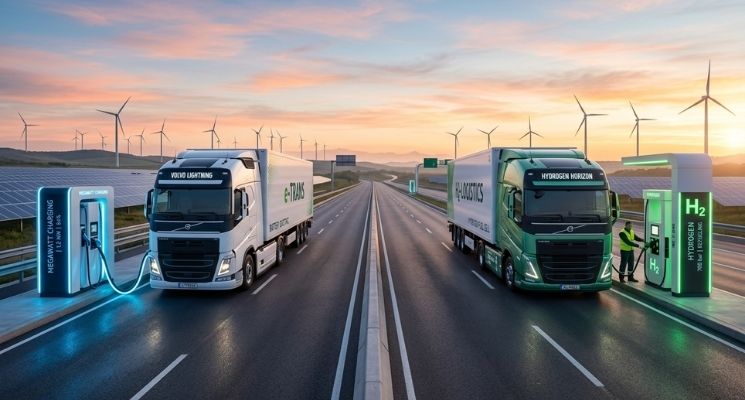
The debate between hydrogen and batteries shouldn’t be a civil war. We are moving toward a “multimodal” energy future where different duty cycles require different solutions. Battery-electric trucks will dominate our cities, our “last-mile” deliveries, and our short-regional hauls. They are efficient, quiet, and perfect for the “return-to-base” model. But for the “long-haul” backbone of the global economy, hydrogen is the only technology that offers the weight, range, and refueling speed necessary to keep the shelves stocked.
The future of green trucking is a landscape where molecules and electrons work together. We are moving away from the “one-fuel” era of diesel and into a more sophisticated, specialized world. While the infrastructure hurdles for hydrogen are massive, the physical limitations of batteries for heavy loads are even more daunting. The transition is already happening, and those who learn to navigate both technologies will be the ones who lead the industry into the next century.
Which way are you leaning? Are you ready to invest in the charging infrastructure for a BEV fleet, or are you waiting for the hydrogen hubs to reach your region? The “Green Revolution” in trucking is no longer a “someday” story—it is a “today” reality. Join the conversation below and tell us which technology you think will ultimately carry the heaviest loads!
FAQ
Is hydrogen dangerous in a crash?
Hydrogen tanks are built to incredible safety standards, often tested with high-caliber gunfire and extreme impact. Because hydrogen is much lighter than air, it dissipates rapidly upward in the event of a leak, unlike gasoline or diesel which pools on the ground and creates a fire hazard.
Can I use my existing diesel mechanics for hydrogen trucks?
A: Fuel cell trucks are essentially electric trucks that make their own power. Your team will need significant retraining on high-voltage systems and compressed gas handling. However, the maintenance on a fuel cell is generally lower than a complex diesel engine with its DPF and SCR systems.
How “green” is hydrogen really?
It depends on the color. “Gray” hydrogen is made from natural gas and emits CO2. “Green” hydrogen is made from water and renewable electricity. The goal of hydrogen fuel cell technology is to move entirely toward “Green” production to ensure true zero-emission logistics.
Will EV trucks ever be able to go 1,000 miles?
Technically yes, but the battery would be so heavy that you could barely carry a load of feathers. Unless we see a “holy grail” breakthrough in battery density (like lithium-sulfur or solid-state), hydrogen remains the only viable 500+ mile zero-emission solution for heavy freight.

3 Comments on “The Heavyweight Bout | Why Hydrogen Might Just Outrun Batteries in the Long Haul”
Comments are closed.